
Answer the Damn Question
You get asked a straightforward question in a meeting, and you answer it for four minutes.
You did not intend to. The question was small, something like why the timeline moved or where a number came from, but in the brief second before you spoke, it stopped being a question and became a test, and you set out to pass it.
We often go beyond the question we were asked, giving a longer explanation meant to also answer the ones we think are hiding underneath.
Someone asks about a decision we made, and we assume they are really asking whether we are competent, whether we have this, whether we should be trusted with it.
Often that assumption is entirely our own. The question was neutral, and we heard a verdict.
So we answer the verdict, reaching for everything we have, the data and the context and the history and the three caveats, building a case for ourselves that no one requested. We were asked for a sentence, but we deliver a defense.
There are other reasons we over-answer. Sometimes we simply know a subject cold and cannot resist showing its full shape, and that is its own thing. The other reason is different. It starts not with what we know but with what we assume.
The trouble is that the defense does not read as competence. It reads as noise. We bury the one or two sentences the person actually needed, we spend time the meeting did not have, and we risk irritating the very people we were trying to reassure.
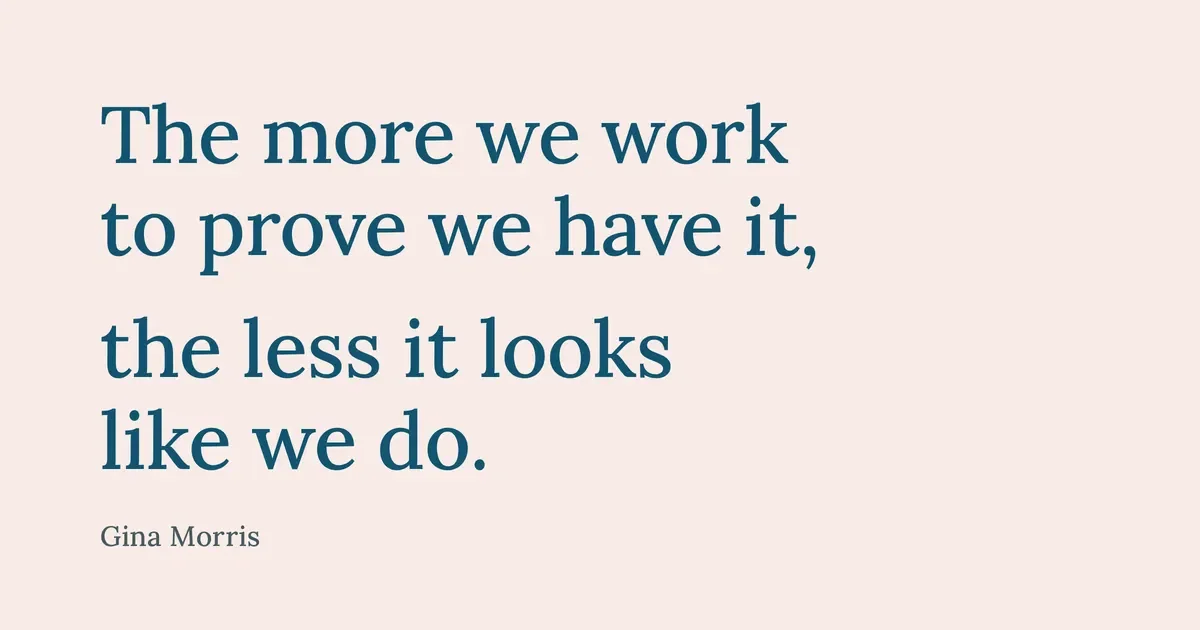
The more we work to prove we have it, the less it looks like we do.
I was leading a workshop recently when one of the participants put it more plainly than I ever could. "Just answer the damn question."
That is the move. When a question lands and it stings, when it strikes the part of you that doubts whether you belong in the room, the work is not to prove yourself. The work is to provide: to hear what was actually asked, and to hand back the best information you have, so the people you are with can do the work they were gathered to do.
Your competence is already in the room. You do not have to argue for it.
Sometimes a question does come with an edge, and that has to be addressed first. Reading that, and handling it, is its own skill. But most of the time there is no edge, only a question, a person who needs an answer, and a room waiting to move.
So the next time a simple question makes you want to prove everything you know, try the most impressive thing you can do. Take a beat, answer what was asked, and trust that if they need more, they will ask.
